Attitude Representations
Brahe supports multiple mathematical representations for the attitude, or orientation, of 3D objects such as spacecraft. Each representation has its own advantages and disadvantages depending on the application. These representations are implemented based on the comprehensive treatment found in Representing Attitude: Euler Angles, Unit Quaternions, and Rotation Vectors by James Diebel.
Overview
Attitude representation is fundamental to spacecraft dynamics and control. Brahe provides four different representations, each with their own advantages:
- Quaternions: Singularity-free, compact representation (4 parameters)
- Rotation Matrices: Direct transformation matrices (9 parameters)
- Euler Angles: Intuitive angular representation (3 parameters, but with singularities)
- Euler Axis: Axis-angle representation (4 parameters)
Conversions
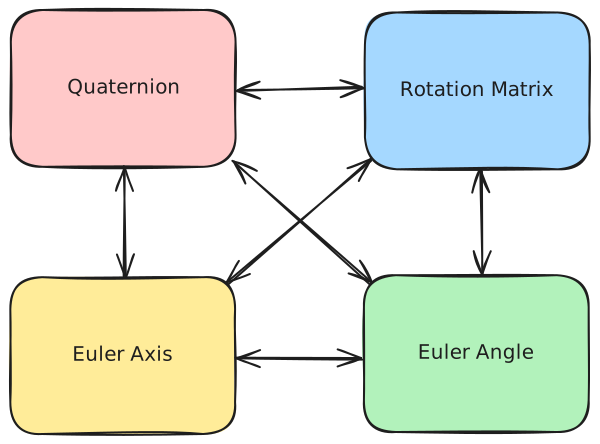
Brahe provides functions to convert between all attitude representations. You can initialize an attitude in one representation and convert it to any other one as needed.
Choosing a Representation
Use Quaternions when:
- Numerical stability is critical
- Interpolating between attitudes
- Propagating attitude dynamics
Use Rotation Matrices when:
- Transforming vectors between frames
Use Euler Angles when:
- Human readability is important
Use Euler Axis when:
- Representing single rotations about an axis
Attitude Frames
An attitude relates two frames: in brahe it is the passive rotation taking vector components in a source frame A to components in a target frame B. Both endpoints are ReferenceFrame values, so any frame the library knows about can serve as either endpoint.
A Celestial endpoint is a frame the frame transformation system evaluates from an epoch alone (GCRF, ITRF, EME2000, and the other members of CelestialFrame); it composes directly with rotation_frame_to_frame. An OrbitRelative endpoint is a local orbital frame such as RTN or LVLH, defined only given an orbit state. A Body endpoint is an object-local frame — a spacecraft body, sensor, or actuator frame — whose orientation the attitude data itself supplies.
Attitude Kinematics
The kinematics functions relate an attitude representation's time derivative to angular velocity, in both directions, for quaternions and for all twelve Euler-angle sequences.